💡What You'll Learn
- How blockchain development is evolving
- Why blockchain technology may become invisible
- How Web3 development improves digital experiences
- The role of smart contracts and DApps
- How Australian businesses can use blockchain
Blockchain is quietly maturing into digital infrastructure that Australian businesses can build on without their customers ever needing to think about it.
The biggest sign that blockchain has succeeded may be the day nobody talks about blockchain anymore.
We remember when the internet felt like magic.
You’d wait for a page to load.
Watch the connection crawl.
Send an email and feel like you’d just witnessed something futuristic.
People talked about “going online” as if the internet were a destination.
Today?
Nobody talks about it.
You wake up, check your phone, order breakfast, transfer money, book a ride, join a meeting and scroll through social media.
You probably don’t think about the internet once.
And that’s the interesting part.
The internet won by becoming boring.
So what happens if blockchain does the same thing?
For businesses across Australia, this could be the real opportunity: using blockchain development, Web3 solutions and digital infrastructure without forcing customers to understand the technology behind them.
From Sydney and Melbourne to Brisbane, Perth and Adelaide, Australian businesses are exploring how emerging technologies can improve financial services, property, supply chains, digital identity and ownership.
The interesting part? The customer may never need to know blockchain is involved.
Why Have We Been Looking at Blockchain the Wrong Way?
For years, blockchain conversations have revolved around the technology itself.
Bitcoin. Ethereum. NFTs. DeFi. Tokens. Wallets. Gas fees. Decentralisation.
The terminology can feel like an entire language.
And that’s partly why mainstream adoption has been slower than many expected.
Because most people don’t wake up thinking, “I need blockchain today.”
They wake up thinking, “I need to send money,” “I need to prove who I am,” “I need to buy something,” or “I need to transfer ownership.”
The technology is secondary.
The outcome is what matters.
That’s exactly where custom blockchain development can become valuable for Australian businesses.
Instead of building technology simply because blockchain is trending, organisations across Australia can use blockchain solutions to solve specific problems around ownership, payments, verification, transparency and digital assets.

Why Does Nobody Say “I’m Using TCP/IP”?
Think about how the internet became mainstream.
Nobody needed to understand TCP/IP before opening Google.
Nobody studied DNS before sending an email.
Nobody learned HTTP before watching YouTube.
The infrastructure became invisible.
That’s the real definition of technological maturity.
People stop caring how it works. They simply expect it to work.
Blockchain may eventually follow the same path, and for businesses exploring Web3 development in Australia, that’s an important shift.
The goal shouldn’t always be to make customers interact with blockchain.
The goal should be to make the experience better because blockchain exists underneath it.
What Would Using Blockchain Without Knowing It Look Like?
Imagine buying a property online in Australia.
You don’t see the word “blockchain.”
You simply receive a verified digital ownership record, transfer ownership, and the transaction is recorded. Done.
Or imagine buying a ticket to an event in Sydney or Melbourne.
You don’t create a crypto wallet. You don’t buy tokens.
You simply receive a digital ticket that can be verified, transferred or resold securely.
No blockchain tutorial. No complicated interface. No 24-word recovery phrase. Just a ticket.
That’s when the technology starts becoming useful.
The same principle applies to tokenisation solutions and real-world asset tokenisation.
For Australian businesses, tokenisation could eventually create new ways to represent ownership, access and value without forcing customers to understand the underlying blockchain infrastructure.
Where Could Invisible Blockchain Make a Difference?
For Australian businesses, blockchain technology could quietly improve several everyday processes:
- Real estate: Digital ownership records and real-world asset tokenisation can make ownership easier to verify and transfer.
- Financial services: Smart contract development can support automated settlements, payments and agreements.
- Supply chains: Blockchain solutions can create more transparent records of where products come from and how they move.
- Digital identity: Verified credentials can help people prove who they are without repeatedly sharing sensitive information.
- Gaming: Web3 development can enable portable digital assets and verifiable ownership.
- Loyalty programmes: Businesses can use tokenisation solutions to create transferable rewards and digital assets.
- Healthcare: Secure records and verifiable credentials could help improve data sharing between authorised parties.
- Education: Digital credentials can make qualifications easier to verify.
- Insurance: Smart contracts could automate certain claims and verification processes.
- Cross-border payments: Blockchain infrastructure can potentially reduce friction when transferring value internationally.
For companies across Australia, the important question isn’t whether blockchain can be used everywhere.
It’s where blockchain can remove friction that existing systems struggle to solve.
Why Might the Best Blockchain Products Hide Blockchain Completely?
This sounds strange considering how heavily the industry markets decentralisation. But think about it.
When cloud computing became mainstream, companies didn’t sell customers on virtual machines.
They sold them speed, scalability and lower infrastructure complexity.
The technology disappeared behind the experience, and blockchain could do the same.
Instead of saying “Powered by blockchain,” a successful Australian product might simply say: “Your ownership is verified.” Or: “Your credentials are portable.” Or: “Your transaction is secure.”
The user doesn’t need to know what is underneath.
This is where blockchain consulting becomes more important than simply choosing a blockchain network.
Australian companies need to understand where blockchain actually creates value — and where it doesn’t.
Does Web3 Have a UX Problem?
Here’s where the industry needs to be honest.
Blockchain products have often asked users to understand too much.
Create a wallet. Save a seed phrase. Understand gas fees. Choose a network. Sign a transaction. Approve a contract. Check an address. Hope you didn’t make a mistake.
For a technology that promises to simplify ownership and trust, that’s a lot of work.
Imagine if every time you sent an email, you had to understand the underlying network protocol. Nobody would use email.
The technology succeeded because the complexity was hidden, and blockchain needs to learn the same lesson.
That’s also why Web3 UX and DApp development matter.
For Australian businesses building Web3 products, a technically impressive decentralised application can still fail if ordinary users find it confusing.
What Could a Better Web3 Experience Look Like?
The next generation of blockchain applications should feel familiar.
A user should be able to:
- Sign in without managing complicated wallet infrastructure.
- Complete transactions without understanding gas fees.
- Verify ownership without reading blockchain data.
- Transfer digital assets through a familiar interface.
- Recover access without relying entirely on technical knowledge.
- Understand exactly what they’re approving.
- See transaction status in simple language.
- Move between platforms without rebuilding their identity.
- Interact with decentralised applications without feeling like they’re using experimental technology.
This is where DApp development, Web3 UX and custom blockchain development become critical.
The blockchain can be complicated. The user experience shouldn’t be.
Do People Actually Want Decentralisation, or Control?
This is an important distinction.
A normal user probably doesn’t care about decentralisation as an abstract concept.
They care about things like: “Can I access my assets?” “Can I trust this transaction?” “Can I move my information?” “Can someone change the record without me knowing?” “Do I actually own what I purchased?”
Blockchain can potentially provide solutions to these problems, but the technology shouldn’t become the product.
The benefit should be the product.
For Australian businesses exploring blockchain, this means starting with the customer problem rather than starting with the technology.
Could Crypto Be the Same?
Crypto has spent years trying to convince people to care about cryptocurrency.
Maybe that’s backwards.
People don’t necessarily need another financial asset. They need better financial infrastructure.
Faster settlement.
Lower friction.
Global transfers.
Programmable payments.
Transparent records.
New forms of ownership.
The Bank for International Settlements has described a future “unified ledger” that brings tokenised money and assets together in one programmable place — a sign this infrastructure conversation now reaches well beyond the crypto industry.
If blockchain infrastructure enables those things quietly in the background, adoption could happen without the average Australian ever calling it “crypto.”
This is where DeFi development, crypto payment solutions, digital wallet development and smart contract development can become infrastructure rather than something users have to think about.
For Australia’s financial technology sector, that distinction could be especially important.
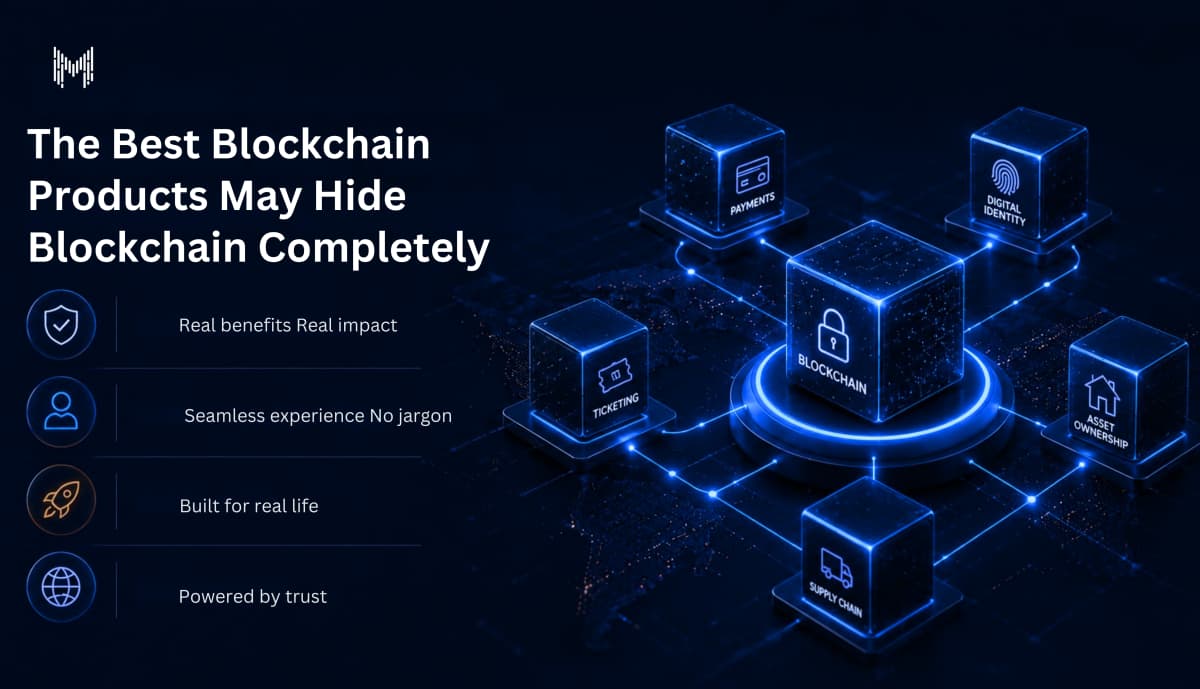
Why Might the Most Successful Blockchain Company Not Look Like One?
This is where things get interesting for businesses.
The winners may not be the companies shouting the loudest about Web3.
They could be the companies quietly integrating blockchain into existing products.
A financial platform. A property marketplace. A logistics network. A gaming ecosystem. A loyalty programme. A digital identity platform.
The customer simply sees a better experience. The blockchain handles the infrastructure.
That’s a much bigger market than selling blockchain itself.
For businesses in Sydney, Melbourne and Brisbane, this could mean integrating blockchain into existing digital products rather than trying to build an entirely separate “Web3” experience.
The same applies to organisations across Australia that are exploring blockchain for finance, property, supply chains and digital assets.
Could Tokenisation Follow the Same Pattern?
We’ve already seen enormous interest in tokenisation.
But the average person doesn’t necessarily want a token. They want ownership.
Imagine owning a fraction of an asset without having to understand the underlying blockchain.
You don’t care which network processes the transaction.
You care about: What do I own? What is it worth? Can I transfer it? Can I verify it? That’s the experience that matters.
This is why real-world asset tokenisation, token development and smart contract solutions could become increasingly relevant to Australian industries such as real estate, finance, entertainment and supply chain.
In Australia, regulators are already responding — the Australian Securities and Investments Commission has reminded digital asset businesses that many token and tokenisation activities may require a financial services licence, so getting the structure right early matters.
The token isn’t the end goal.
The utility is.
What Could Australian Businesses Tokenise?
Tokenisation isn’t limited to cryptocurrency.
Australian businesses could potentially explore tokenisation for:
- Real estate ownership
- Investment assets
- Digital memberships
- Loyalty rewards
- Event tickets
- Intellectual property
- Gaming assets
- Collectibles
- Supply-chain records
- Digital credentials
- Access passes
- Fractional ownership models
The important part isn’t putting everything on a blockchain.
It’s identifying assets where verifiable digital ownership, transferability or transparency creates genuine value.
That’s where tokenisation development and smart contract development can move beyond hype and into practical business applications.
Why Is Boring Technology Usually Powerful Technology?
Electricity is boring. Nobody celebrates electricity every morning.
Cloud computing is boring. Nobody gets excited about a server cluster.
The internet is boring. Nobody posts about DNS.
Yet all three transformed the world.
That’s what mature infrastructure looks like.
It becomes so reliable and normal that we stop thinking about it.
Blockchain shouldn’t be afraid of becoming boring. It should aim for it.
Imagine a future where a business in Melbourne uses blockchain for verification, a property platform in Sydney uses tokenisation for ownership, and a financial company in Brisbane uses smart contracts for settlement.
Customers don’t need to understand any of it. They simply experience a better product.
What Are the Signs Blockchain Is Becoming Mainstream?
We may know blockchain has matured when:
- Customers stop asking which blockchain a product uses.
- Businesses stop marketing blockchain as the product.
- Wallets become as simple as everyday payment apps.
- Smart contracts operate quietly in the background.
- Digital ownership becomes normal.
- Tokenised assets become easier to understand.
- Blockchain transactions feel as simple as online payments.
- Web3 applications look and feel like normal applications.
- Australian businesses use blockchain without calling themselves “Web3 companies.”
- Customers care about what the technology does rather than what technology it uses.
That might sound like blockchain disappearing.
It isn’t.
It’s blockchain becoming infrastructure.
What Should Australian Businesses Ask Before Building on Blockchain?
Before investing in a blockchain project, organisations should ask:
- What problem are we actually solving?
- Does blockchain solve it better than traditional technology?
- What does the customer gain?
- What data should be stored on-chain?
- What needs to remain private?
- Which blockchain network makes sense for the use case?
- How will users interact with wallets and transactions?
- How will smart contracts be secured?
- How will the system scale as adoption grows?
- What happens if something goes wrong?
- How will the product integrate with existing systems?
- Can users understand the experience without understanding blockchain?
For Australian organisations exploring blockchain consulting, these questions should come before choosing a technology stack.
Because the best blockchain strategy isn’t necessarily the one with the most blockchain.
It’s the one that creates the most value with the least unnecessary complexity.
Why Choose Mkaits Technologies for Blockchain Development?
Building a blockchain product isn’t simply about writing smart contracts or launching a token.
At Mkaits Technologies, our approach is focused on building blockchain solutions around the actual business problem.
We can help businesses explore and develop solutions across:
- Custom Blockchain Development
- Smart Contract Development
- DApp Development
- DeFi Development
- Web3 Development
- Token Development
- Real-World Asset Tokenisation
- Digital Wallet Development
- Blockchain Integration
- Blockchain Consulting
- Web3 Product Development
- Blockchain Security and Smart Contract Auditing
Our team works across blockchain, AI, cloud and custom software development, allowing businesses to connect emerging technologies with their existing digital infrastructure.
For Australian companies, whether you’re operating in Sydney, Melbourne, Brisbane or elsewhere across Australia, the objective isn’t to add blockchain simply because it’s popular.
It’s to build technology that creates measurable value.
We don’t believe blockchain should make products more complicated. We believe it should make them better.
Why Does This Matter for Australian Businesses?
The opportunity isn’t simply to “use blockchain.”
It’s to identify where blockchain can make a product more transparent, secure, transferable or efficient.
That could mean building a custom blockchain solution, developing a DApp, automating agreements through smart contracts, creating digital wallets, exploring DeFi applications, or tokenising real-world assets.
For businesses across Australia, the question shouldn’t be, “How do we add blockchain?”
It should be, “What can we make better by using it?”
That’s the difference between building a blockchain product and building a product that happens to use blockchain.
The best thing that could happen to blockchain is for it to become boring
The internet became powerful when people stopped thinking about the internet.
Nobody says, “I’m going to use TCP/IP now.”
They simply open a browser.
Blockchain could reach the same point.
And when it does, something ironic might happen.
The crypto conferences may get quieter.
The blockchain buzzwords may disappear.
The average Australian may stop talking about decentralisation.
And nobody may care what network is processing their transaction.
Because the technology will simply work.
That’s when blockchain will have truly arrived.
Not when everyone understands blockchain.
When nobody needs to.
The future of blockchain may not be louder.
It may be quieter, invisible, reliable and incredibly boring.
And honestly? That might be the best thing that could happen to it.
Whether you’re building in Sydney, Melbourne, Brisbane or anywhere else across Australia, the most valuable blockchain solution may ultimately be the one your customers never notice.
Explore our blockchain development and wider services to see where we can help.