💡What You'll Learn
- Why the AI bubble isn't bursting
- How AI is becoming infrastructure
- Why hype differs from real value
- What successful AI companies do
- How businesses should adopt AI
Everyone is asking when the AI bubble will pop.They're asking the wrong question.
A few months ago, I overheard two founders talking at a startup event.
One of them looked around the room, laughed, and said:
"Everything is AI now."
AI startups.
AI consultants.
AI agencies.
AI-powered toothbrushes.
AI note-taking apps.
AI everything.
The other founder smiled and replied,
"Give it a year. The bubble will burst."
I didn't say anything.
But I kept thinking about that conversation.
Because we've seen this movie before.
When the internet exploded, people said it was a bubble.
When smartphones arrived, people said there were too many apps.
When cloud computing took off, critics argued businesses would never trust their data to someone else's servers. Some companies disappeared.
The technology didn't.
That's the part history keeps repeating.
And I think we're making the same mistake with AI.
The AI bubble isn't about to burst.
It's about to grow up.
Every Technology Goes Through the Same Three Stages
At first, everyone ignores it.
Then everyone overhypes it.
Finally, it becomes so normal that nobody talks about it anymore.
Think about electricity.
People don't wake up excited that their lights work.
They just expect them to.
The internet followed the same path.
So did cloud computing.
So did smartphones.
AI is simply moving through the same cycle.
The headlines may change.
The technology won't.
Right Now, We're Still in the "Everything Is AI" Phase
Let's be honest.
Companies are adding AI to products whether it belongs there or not.
Some businesses have changed nothing except their marketing.
"AI-powered."
"AI-first."
"Built with AI."
Sometimes it's genuine innovation.
Sometimes it's just a new label on an old product.
That doesn't mean AI is overhyped.
It means businesses are behaving exactly as they always do during the early stages of a technological shift.
We Saw This During the Dot-Com Boom
In the late 1990s, companies rushed to add ".com" to their names.
Investors poured money into businesses with little more than a website and a dream.
Eventually, many of those companies failed.
People called it proof that the internet had been overrated.
But look at the world today.
The internet didn't fail.
Weak business models did.
The same thing is happening with AI.
AI Isn't the Product Anymore
It's Becoming the Infrastructure
This is the shift many people haven't noticed.
Today, AI still feels like a feature.
Tomorrow, it will feel like electricity.
You won't ask whether software uses AI.
You'll assume it does.
Just as you don't ask whether a company uses cloud computing.
It's simply part of modern business.
The companies that survive won't be the ones shouting the loudest about AI.
They'll be the ones using it so well that customers barely notice.
The Real Winners Won't Be the Loudest Startups
History has a funny way of rewarding the quiet builders.
During every technology boom, attention flows toward flashy products.
But long-term value often comes from infrastructure.
Think about what businesses actually need:
- Better decision-making
- Faster customer support
- Smarter logistics
- More efficient operations
- Improved cybersecurity
- Predictive analytics
- Intelligent automation
These aren't exciting headlines.
They're billion-dollar opportunities.
AI Is Shifting From Novelty to Necessity
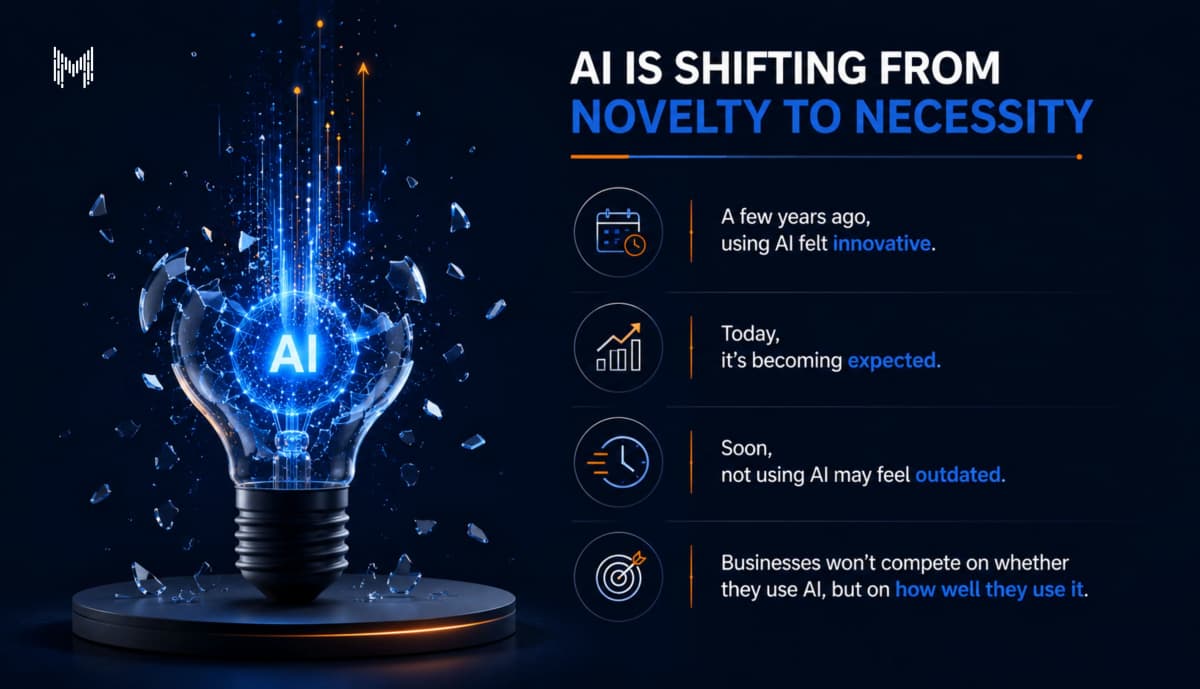
A few years ago, using AI felt innovative.
Today, it's becoming expected.
Soon, not using AI may feel outdated.
That's a massive transition.
Businesses won't compete on whether they use AI.
They'll compete on how well they use it.
The Bubble Isn't AI
It's Expectations
One of the biggest misconceptions is believing AI can solve every problem.
It can't.
AI won't rescue a bad product.
It won't fix poor leadership.
It won't magically create demand.
And it certainly won't replace strategy.
Technology amplifies what already exists.
If your business is efficient, AI can make it faster.
If your business is disorganized, AI can make mistakes at scale.
That's why implementation matters more than hype.
The Companies That Win Will Ask Better Questions
Instead of asking,
"How can we add AI?"
They'll ask,
"What problem are we solving?"
That sounds simple.
But it's surprisingly rare.
The best AI implementations are often invisible.
Customers don't care that an algorithm handled their request.
They care that the experience was faster, smoother, and easier.
AI Is Becoming Like the Internet
Imagine launching a company today and proudly announcing,
"We use the internet."
Nobody would be impressed.
It's expected.
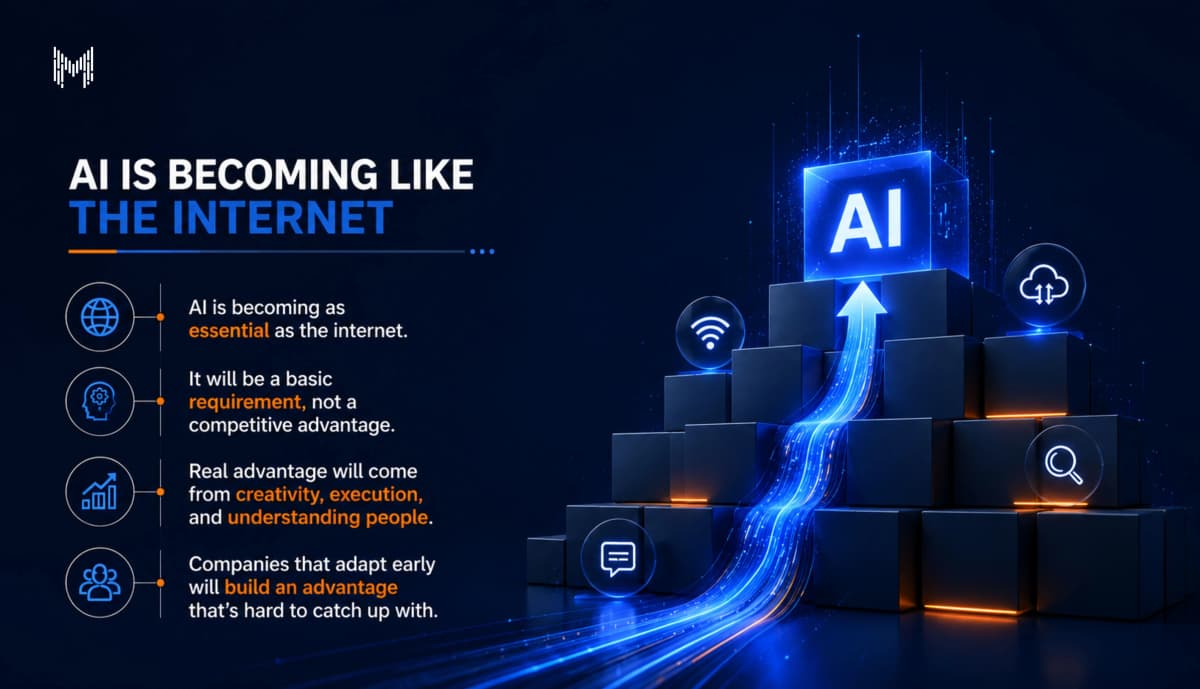
That's exactly where AI is heading.
Within a few years, AI won't be a competitive advantage by itself.
It will be a basic requirement.
The real advantage will come from creativity, execution, and understanding people.
Growth Looks Different This Time
Unlike previous technology waves, AI is improving incredibly fast.
Every few months, new models become more capable.
Costs continue to decrease.
Access continues to expand.
That means innovation isn't slowing down.
It's accelerating.
Which makes predictions about a sudden collapse seem less convincing.
The technology is becoming more useful, not less.
The Companies That Should Be Worried
Ironically, the biggest risk isn't for AI companies.
It's for businesses pretending AI doesn't matter.
Because while some are waiting for the "bubble" to burst, others are redesigning workflows, automating operations, and creating products that simply weren't possible a few years ago.
By the time AI feels ordinary, those early adopters may have already built an enormous advantage.
The Future Won't Feel Like AI
It Will Just Feel Better
Think about the products you love most.
You rarely think about the technology behind them.
You remember how easy they are to use.
How quickly they solve your problem.
How naturally they fit into your life.
That's where AI is headed.
Not as a headline.
As an expectation.
Why Choose Mkaits Technologies
At Mkaits Technologies, we help businesses move beyond AI hype and build intelligent solutions that deliver measurable results.
Our expertise includes:
- Custom AI Development
- AI Agent Solutions
- Intelligent Process Automation
- Machine Learning Integration
- AI + Blockchain Solutions
- Cloud Infrastructure
- Custom Software Development
Because the future belongs to businesses that use AI with purpose not just publicity.
Every technological revolution attracts hype.
That's normal.
Some AI startups will disappear.
Some products will fail.
Some investors will lose money.
That doesn't mean AI is a bubble waiting to burst.
It means the market is maturing.
The companies chasing trends will struggle.
The companies solving real problems will thrive.
Because the future of AI isn't about adding another chatbot or generating another image.
It's about building businesses that are faster, smarter, and more human-centered.
The AI bubble isn't ending.
It's growing up.
And the companies that understand that today won't just survive the next decade.
They'll help define it.