💡What You'll Learn
- How AI is transforming finance
- Why AI needs human oversight
- The role of governed AI agents
- How AI improves finance workflows
- Why trust matters in AI automation
The future of finance isn't humans versus AI. It's AI that can move fast, with humans still holding the keys.
Imagine your finance team starts Monday morning with 4,000 invoices waiting to be processed.
Some are duplicates.
Some are missing documents.
Some don't match purchase orders.
A few require approval from senior management.
And somewhere in the middle of all that paperwork is one invoice that shouldn't be paid at all.
For years, someone had to find it.
Someone had to check it.
Someone had to route it.
Someone had to approve it.
Someone had to enter the information into another system.
And someone had to make sure the entire process was documented.
Now imagine an AI agent doing most of that work.
It reads the invoice.
Checks it against existing records.
Detects a possible duplicate.
Identifies that supporting documentation is missing.
Routes it to the right person.
And waits.
It doesn't approve the payment.
Because it isn't allowed to.
That's the difference between automation and governed AI.
And it may define the future of finance.
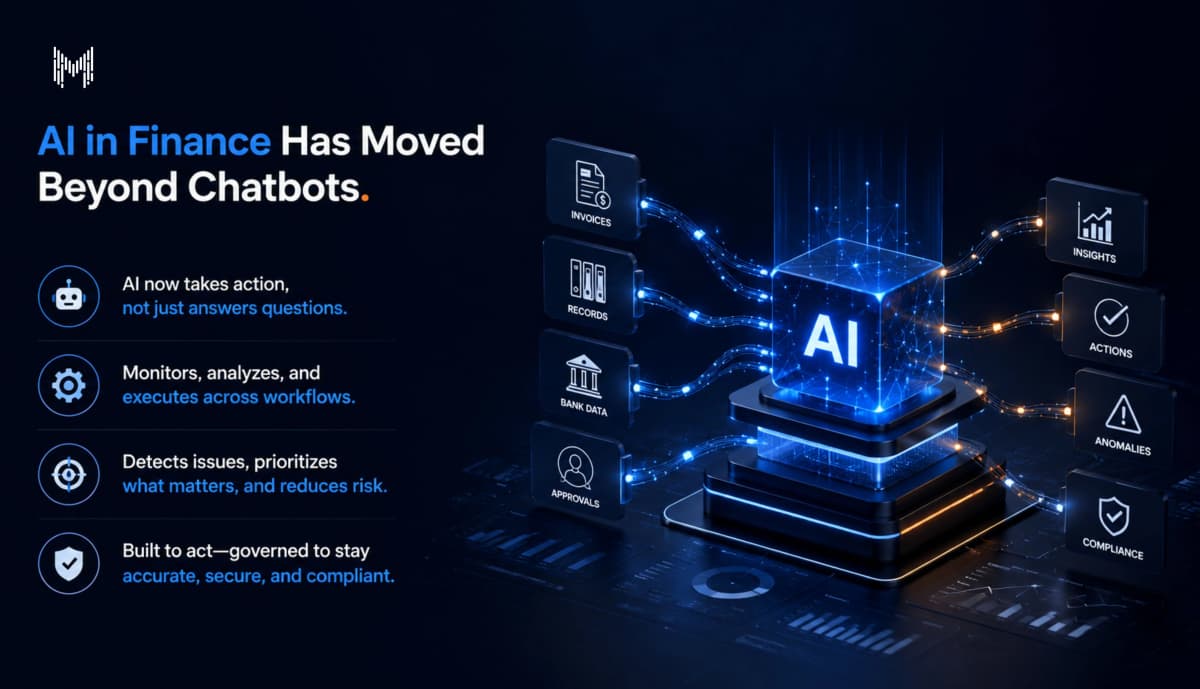
AI in Finance Has Moved Beyond Chatbots
When people talk about AI in finance, they often imagine a chatbot answering questions.
"What were our expenses last quarter?"
"Show me this month's revenue."
That's useful.
But it's only the beginning.
The next generation of AI systems won't simply answer questions.
They'll take action.
They'll monitor transactions.
Identify anomalies.
Prepare reconciliations.
Prioritize collections.
Detect missing documents.
Generate reports.
And coordinate workflows across multiple systems.
This is where AI agents enter the picture.
An AI agent can observe what's happening, reason about what needs to happen next, and execute predefined actions.
But here's the problem.
The ability to act is also the ability to make mistakes.
And in finance, mistakes can be expensive.
The Most Dangerous AI Is the One With Too Much Permission
Imagine giving an AI agent access to your company's entire financial infrastructure.
It can:
- Create vendors.
- Approve invoices.
- Move money.
- Change payment details.
- Access sensitive financial records.
Technically, it might be incredibly efficient.
Operationally, it could be a disaster.
One incorrect decision could trigger a payment.
One manipulated document could bypass a control.
One compromised account could create a chain reaction.
That's why the future of AI in finance shouldn't be:
"Let AI do everything."
It should be:
"Let AI do what it's authorized to do."
The MKAITS Agentic Finance Operating Model
The idea behind a governed agentic finance model is simple.
AI should be able to act.
But every action should happen within clearly defined boundaries.
Think of it like giving an employee access to a company's financial systems.
You don't give every employee unlimited authority.
You define their role.
You establish approval limits.
You control access.
You monitor activity.
You keep records.
You review exceptions.
AI agents should be treated with the same discipline.
In a governed finance environment, every AI action should have:
- Defined permissions
- Role based access
- Approval thresholds
- Human oversight
- Document traceability
- Version history
- Exception reporting
- Complete audit trails
The goal isn't to slow AI down.
It's to make AI trustworthy enough to operate at scale.
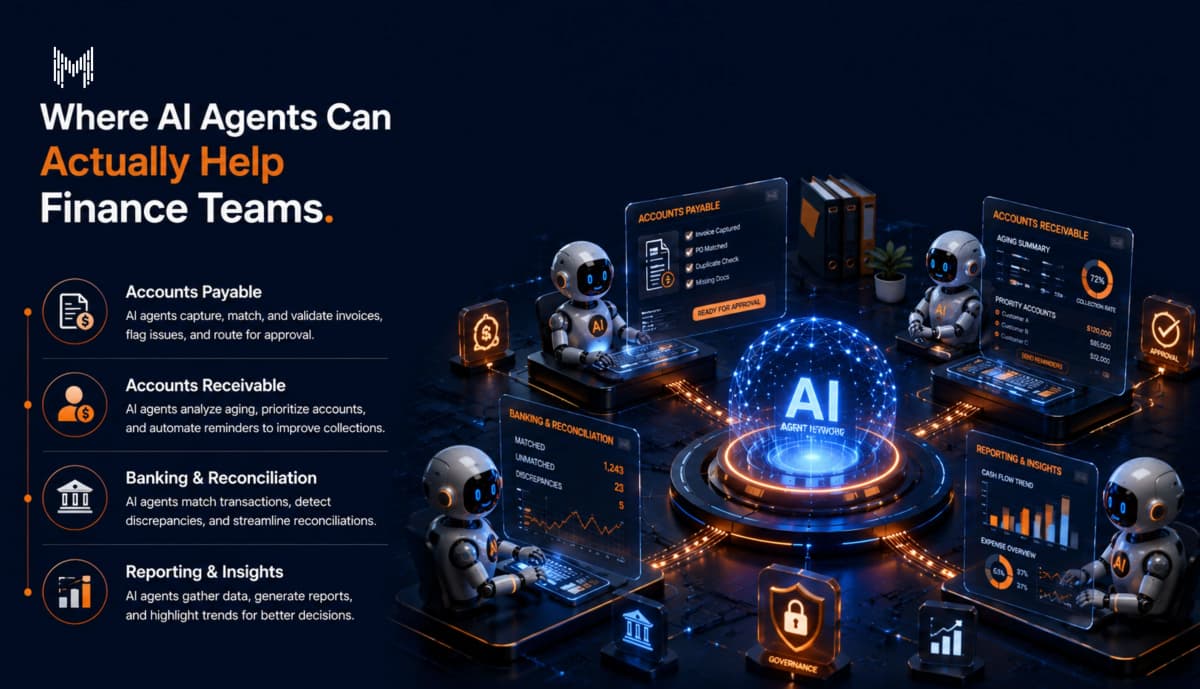
Where AI Agents Can Actually Help Finance Teams
The opportunity isn't about replacing finance departments.
It's about removing the repetitive work that consumes their time.
Accounts Payable
Imagine an AI agent receiving hundreds of invoices every day.
Instead of someone manually checking every document, the system can:
- Capture invoice information.
- Match invoices against purchase orders.
- Detect duplicate submissions.
- Identify missing documents.
- Flag unusual amounts.
- Route invoices for approval.
The AI handles the repetitive work.
Humans handle judgment.
That's the model.
Accounts Receivable
Late payments are rarely a single problem.
Finance teams need to know:
Who hasn't paid?
How long has the payment been overdue?
Which customers are high priority?
Who needs a reminder?
Who needs a conversation?
AI agents can analyze ageing reports, prioritize accounts, and automate routine reminders.
But decisions involving sensitive customer relationships can still require human involvement.
The agent identifies the situation.
The human decides how to handle it.
Banking and Reconciliation
Bank reconciliation is another area where AI can reduce manual effort.
An intelligent system can compare transactions across multiple sources and identify:
- Matching transactions
- Missing entries
- Duplicate transactions
- Unusual activity
- Exceptions requiring review
Instead of spending hours searching for discrepancies, finance professionals can focus on resolving the exceptions that actually matter.
Tax and Compliance
This is where governance becomes especially important.
AI can help identify:
- Missing documents
- Potential WHT issues
- GST inconsistencies
- Unusual transactions
- Compliance gaps
But compliance decisions shouldn't become a black box.
Finance teams need to know:
Why was something flagged?
What information was used?
Which version of the model made the decision?
Who reviewed it?
What action was ultimately taken?
That's why traceability matters.
Automation Alone Isn't Transformation
This is where many organizations get AI wrong.
They automate a process.
Then they call it transformation.
But if you automate a broken process, you simply make the broken process faster.
Real transformation requires asking deeper questions.
Why does this process exist?
Where are the bottlenecks?
Which decisions require human judgment?
Which tasks can be delegated?
What happens when the AI is wrong?
Who is accountable?
What happens when the system encounters something it doesn't understand?
The answer shouldn't be:
"The AI will figure it out."
It should be:
"The AI will know when it needs help."
The Exception Is More Important Than the Average
AI is extremely good at handling repetitive patterns.
Finance is full of them.
But businesses don't usually lose money because everything went according to plan.
They lose money because something unusual happened.
An invoice didn't match.
A payment went to the wrong account.
A transaction looked suspicious.
A document was missing.
A tax rule changed.
A customer disputed a charge.
That's why a good AI finance system shouldn't only automate normal workflows.
It should be designed around exceptions.
The question isn't just:
"Can AI process this?"
It's:
"What happens when AI can't process this?"
That question changes everything.
Humans Shouldn't Be Removed From the Loop
There's a dangerous assumption surrounding AI automation.
That the ultimate goal is to eliminate human involvement.
But in finance, human oversight isn't necessarily inefficiency.
Sometimes it's governance.
A good system knows when to stop.
For example:
An AI agent can identify an invoice as low risk and route it through an automated workflow.
But if the invoice exceeds a predefined threshold, the system can require human approval.
If the vendor's bank details suddenly change, the system can pause the transaction.
If the transaction appears unusual, it can escalate it.
The AI doesn't disappear.
It becomes more intelligent about when it needs a human.
That's what human in the loop AI should look like.
The Future Finance Team Will Look Different
Finance professionals aren't going away.
Their work is changing.
Instead of spending most of their time entering data, chasing documents, and reconciling transactions, they can spend more time on:
- Financial strategy
- Business planning
- Risk management
- Forecasting
- Decision making
- Compliance oversight
- Strategic analysis
AI handles the repetitive.
Humans handle the consequential.
That isn't a threat to finance professionals.
It's an opportunity to move finance closer to the center of business strategy.
Trust Will Become the Real Competitive Advantage
Every company will eventually have access to AI.
That won't be the differentiator.
The differentiator will be whether customers, employees, regulators, and business leaders trust the systems making decisions.
A company that can say:
"Our AI can act, but we know exactly what it can do."
is in a much stronger position than one that says:
"Our AI does everything automatically."
The first company has governance.
The second has exposure.
The Question Isn't "Can AI Do It?" — It's "Should AI Do It?"
This may be the most important question businesses need to ask.
AI can probably automate thousands of tasks.
That doesn't mean it should.
Some decisions are too sensitive.
Some actions require accountability.
Some situations need empathy.
Some risks are simply too high.
The goal isn't maximum automation.
The goal is responsible automation.
Why Choose Mkaits Technologies
At Mkaits Technologies, we believe the future of AI isn't uncontrolled automation. It's intelligent systems designed with governance, security, and measurable business outcomes at their core.
We help organizations explore and implement AI solutions that can support real operational needs while maintaining appropriate human oversight and control.
Our expertise includes:
- AI Agent Development
- Agentic AI Solutions
- AI Powered Automation
- Custom Software Development
- AI + Blockchain Solutions
- Cloud & Digital Transformation
- Enterprise Technology Solutions
The goal isn't to automate everything.
It's to automate what makes sense while keeping humans in control of what matters most.
The future of finance won't be built by choosing between humans and AI.
It will be built by designing systems where both do what they are best at.
AI can process enormous amounts of information, detect patterns, work continuously, and automate repetitive workflows.
Humans can provide judgment, context, accountability, ethics, and strategic thinking.
The most powerful finance teams will combine both.
But there's one principle we shouldn't forget:
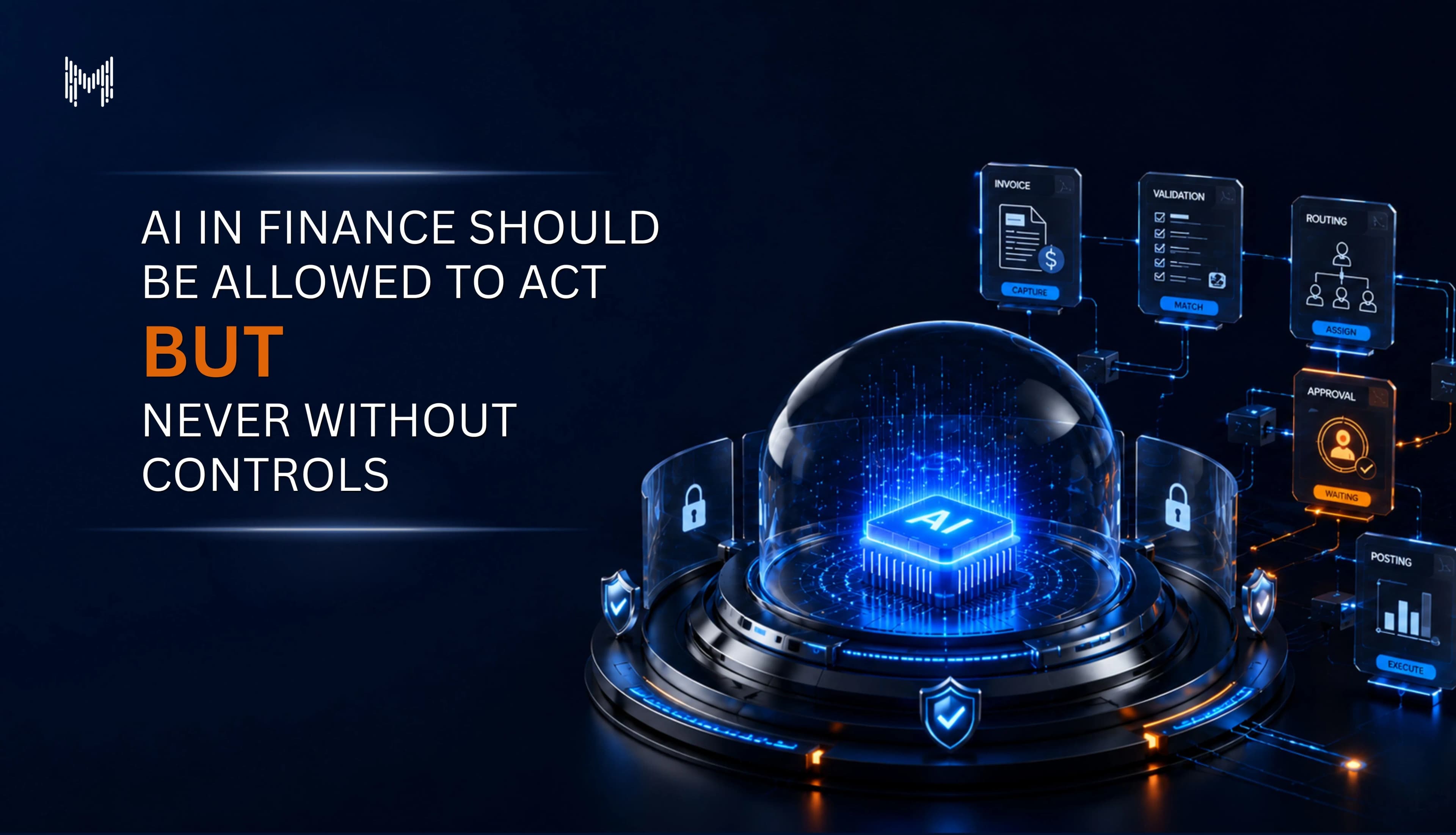
AI in finance should be able to act but never without controls.
Because the future isn't about building AI that can do everything.
It's about building AI that knows what it's allowed to do, when it should act, and when it should step aside.
That's when automation becomes transformation.
That's when AI becomes enterprise-ready.
And that's when finance can finally spend less time processing the past and more time shaping what's next.