

💡What You'll Learn
- Why many people enter crypto for profit
- The gap between crypto vision and reality
- How speculation helped grow the crypto industry
- Why crypto adoption is still slow
- Why real utility will shape crypto’s future
They’re here for the money and that’s not necessarily a bad thing.
Let’s be honest for a moment.
When most people say they’re “into crypto,” what they really mean is:
They’re hoping the price goes up.
Not the technology.
Not the decentralization movement.
Not the philosophical ideas about financial freedom.
Just the price.
And if that statement makes people uncomfortable, it’s probably because it’s true.
Crypto communities love to talk about changing the world, replacing banks, and building decentralized systems.
But if markets stopped moving tomorrow, a huge percentage of people would disappear overnight.
That’s the uncomfortable reality.
The Narrative vs The Reality
Crypto has always had two narratives running at the same time.
The first is the visionary narrative.
A future where:
- financial systems are decentralized
- users control their own assets
- middlemen disappear
- global finance becomes open and borderless
It’s an exciting idea.
But the second narrative is the speculation narrative.
And that one is much simpler.
Buy low.
Sell high.
That’s the part most people actually care about.
Speculation Built the Industry
Here’s the truly unpopular part:
Speculation is the reason crypto exists today.
Without speculation:
- there would be far less capital in the ecosystem
- fewer developers building projects
- fewer startups exploring blockchain technology
- far less attention from institutions
Markets move because people believe they can profit.
And that belief funds innovation.
Every major tech shift in history had the same dynamic.
The internet boom.
The dot-com bubble.
Even early startup ecosystems.
Speculation often comes before real utility.
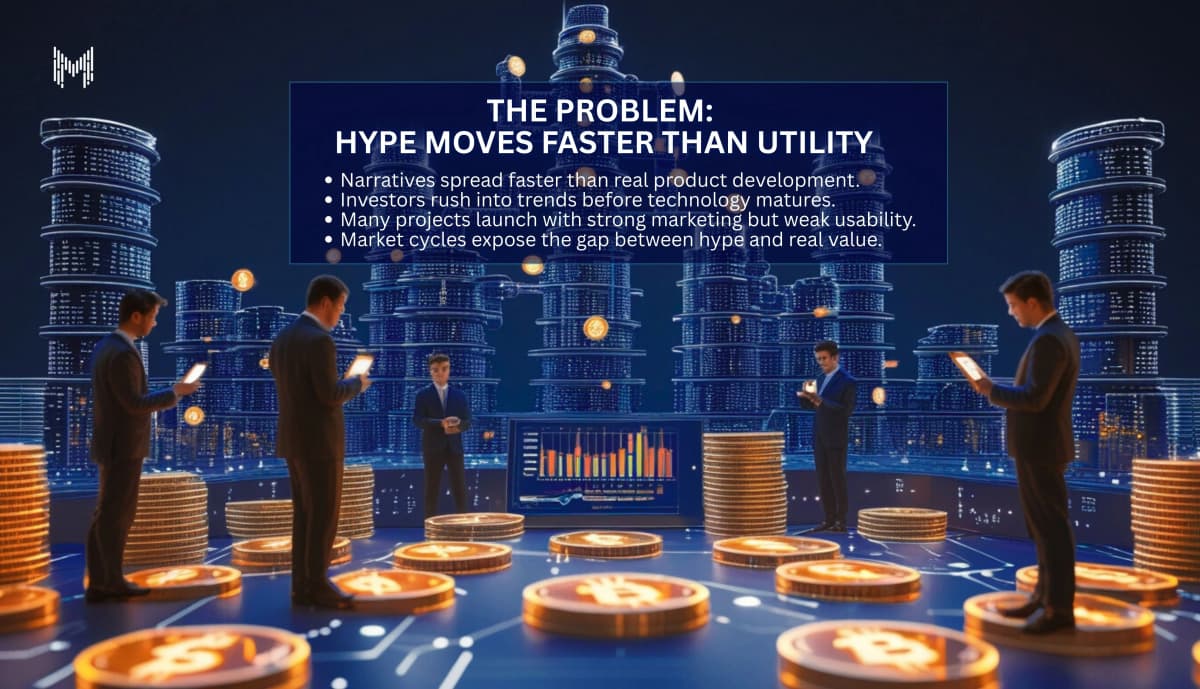
The Problem: Hype Moves Faster Than Utility
While speculation helped crypto grow, it also created a major problem.
Hype moves much faster than real-world use cases.
Every cycle we see the same pattern:
A new narrative appears.
- NFTs will change everything
- Metaverse will replace the internet
- Play-to-earn will reshape gaming
- DeFi will replace banks
Investors rush in.
Prices skyrocket.
Then reality catches up.
And many projects disappear.
Not because the technology is useless.
But because the hype arrived before the product was ready.
The Harsh Truth: Most Crypto Products Are Still Hard to Use
Another unpopular opinion:
Crypto products still struggle with user experience.
Wallets are confusing.
Gas fees are unpredictable.
Security risks are intimidating.
For people inside the industry, these things feel normal.
But for the average user, they’re overwhelming.
This is why mainstream adoption still moves slowly.
Not because people don’t care about decentralization.
But because most people care about simplicity first.
The Industry Is Slowly Maturing
Despite the chaos, something interesting is happening.
Crypto is starting to grow up.
Instead of purely speculative projects, we’re seeing serious development around:
- Real-world asset tokenization
- Blockchain-based financial infrastructure
- Stablecoins and cross-border payments
- Decentralized identity systems
- Enterprise blockchain adoption
These use cases focus less on hype and more on solving real problems.
And that’s where the industry starts to become sustainable.
Real Value Will Come From Real Utility
Long-term success in crypto won’t come from viral tokens or temporary hype cycles.
It will come from products that actually work.
Products that:
- simplify financial systems
- increase transparency
- unlock liquidity in traditional markets
- reduce friction in global transactions
That’s where blockchain technology becomes powerful.
Not as a trend.
But as infrastructure.
The Next Phase of Crypto
The next phase of the crypto industry will likely look very different from the last one.
Less hype.
More infrastructure.
Less speculation.
More real-world integration.
We’re already seeing this shift with developments around:
- tokenized real-world assets (RWA)
- institutional blockchain adoption
- AI and blockchain integration
- digital identity solutions
The projects that survive this transition won’t be the loudest.
They’ll be the ones solving real problems.

So here’s the unpopular opinion again:
Most people didn’t enter crypto because they believed in decentralization.
They entered because they believed in profit.
And that’s okay.
Speculation might have brought people into the ecosystem.
But utility is what will keep the industry alive.
The future of crypto won’t be decided by hype cycles.
It will be decided by the projects that actually deliver real-world value.